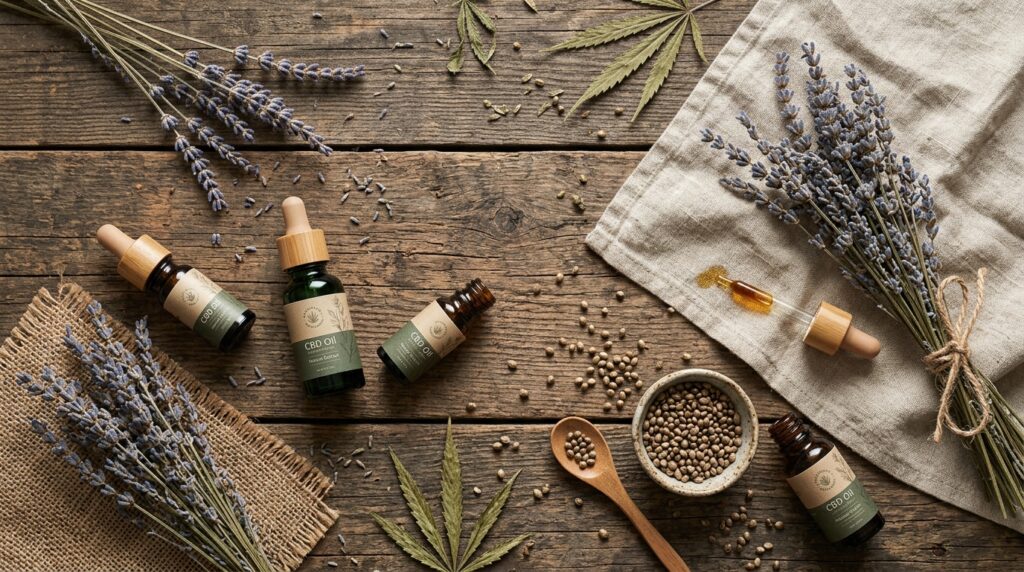
Two bottles sit on the same shelf. Both look green-tinged, both mention hemp, and one costs several times more than the other. The price gap exists because CBD oil and hemp seed oil are different products made from different parts of the plant. Mixing them up is one of the most common mistakes in the category, and it tends to cost shoppers money.
Two Oils, Two Plant Parts
Hemp seed oil
This one is pressed, much like olive oil. Seeds from the hemp plant are cold-pressed to release a pale green oil. Seeds contain almost no cannabinoids, so the finished oil carries little or no CBD. A trace of THC can occur from resin on the seed surface, which is why batch testing still matters.
The value lies in the fats. Hemp seed oil is roughly 70 to 80 percent polyunsaturated fat, led by linoleic acid (an omega-6) and alpha-linolenic acid (an omega-3) in a ratio near 3 to 1. It also carries vitamin E and small amounts of gamma-linolenic acid.
In December 2018 the FDA responded to three GRAS notices covering hulled hemp seed, hemp seed protein, and hemp seed oil, stating it had no questions about the conclusions. Food use is established in a way that CBD products cannot claim.
CBD oil
CBD oil is extracted. Makers use CO2 or ethanol to pull cannabinoids from the flowers, leaves, and stalks, then blend the extract into a carrier oil. The flowers of CBD-rich cultivars hold the bulk of the cannabinoids, and the seeds hold almost none.
Here is where confusion deepens: many CBD oils use hemp seed oil as the carrier. A bottle can legitimately contain both, with the seed oil as the base and the extract as the active ingredient. Outside the Epidiolex prescription, the FDA has not approved any CBD product.
| CBD oil | Hemp seed oil | |
|---|---|---|
| Made from | Flowers, leaves, stalks | Seeds |
| Method | CO2 or ethanol extraction, blended into a carrier | Cold pressing |
| Main compounds | Cannabidiol, plus other cannabinoids and terpenes depending on type | Fatty acids, vitamin E |
| THC | Trace in full spectrum, none intended in isolate | None to trace |
| Common use | Drops, capsules, topicals | Dressings, skin care, low-heat cooking |
| Regulatory status | Not FDA-approved over the counter | Hemp seed ingredients drew no FDA objection in 2018 |
How Labels Blur the Line
Naming is loose in this market. A single word on the front of a bottle can point to either product, and the fine print settles it.
| Label term | Usually means |
|---|---|
| Hemp seed oil, Cannabis sativa seed oil | Pressed from seeds, no meaningful CBD |
| Hemp extract, full spectrum hemp extract | Extract from the plant’s aerial parts, typically containing CBD |
| Phytocannabinoid-rich (PCR) | Cannabinoid-containing extract |
| Hemp oil | Ambiguous, could be either |
| Cannabidiol or CBD with a milligram figure | Stated cannabinoid content |
A big number on the front is not always a CBD number. A figure printed beside “hemp oil” can describe the weight of the seed oil in the bottle. The supplement facts panel should list cannabinoids by name, and a lab report should confirm them.
Quick checks before paying:
- The word “cannabidiol” or “CBD” on the ingredient list, with an amount in milligrams
- A batch number that matches a third-party lab report
- A stated carrier oil
- A clear THC result on that report
- A price per milligram of CBD that makes sense next to similar products
Which One Fits the Goal
Cooking and skin care
Hemp seed oil fits the kitchen. It tastes grassy and nutty, works in dressings and smoothies, and has a low smoke point, roughly 165°C (330°F), so it belongs on cold dishes. It spoils faster than most oils. A dark bottle in the refrigerator, used within a few months of opening, keeps it fresh.
Cannabinoid products
Someone looking for cannabidiol needs a product that lists it. Seed oil will not deliver it, however good the omega-3 content. CBD oil also deserves the cautions from the research: no over-the-counter approvals, a risk of liver effects, and possible interactions with medicines.
Drug testing
Standard federal workplace urine screens look for a THC metabolite, with an initial cutoff of 50 ng/mL. Full spectrum CBD oil contains trace THC, and heavy daily use can add up. People subject to testing often pick isolate, and they confirm THC results on a lab report instead of trusting a label. Seed oil from a tested batch carries very little risk, though a cold-pressed seed oil with no report offers no guarantee.
Money
Food-grade hemp seed oil sells like other specialty culinary oils. A small CBD tincture can cost more than a large bottle of seed oil. The price difference reflects extraction, testing, and compliance costs, along with plain market demand.
Laws and borders
Both products start from hemp, which U.S. federal law defines as cannabis with no more than 0.3 percent delta-9 THC by dry weight. State rules differ, and other countries draw their own lines. A product that is ordinary in one place can be restricted in another, which matters for travel.
Final Thoughts
CBD oil and hemp seed oil share a plant and a color, and little else. Seed oil is a food fat pressed from seeds, and CBD oil is a cannabinoid extract blended into a carrier. The ingredient list and a batch-specific lab report settle which one is in the bottle. Shopping by those two items beats shopping by the word “hemp.”